


Spiderwood is a well-known choice in aquariums. It's easy to find, often affordable and quickly gives that sprawling, branchy feel that many recognise from aquascaping images.
But that's also part of the limitation. Spiderwood has quite a distinct look. Many pieces look similar, and the result is easily an aquarium that looks like many others.
Tuskwood is a different way of thinking about aquarium roots. Here it's not just about putting in a decoration. It's about choosing a natural object that can make the whole aquarium more special, more thoughtful and more rewarding over time.
Spiderwood has a style. Tuskwood offers more possibilities.
Spiderwood often does one thing well: relatively thin, branching shapes with a clear, airy expression. This can be nice, especially if you want to build a light and fast scape with a lot of branch structure.
But that look is also quite recognisable. When many people use the same type of root from the same kind of production, many aquariums end up with the same visual style.
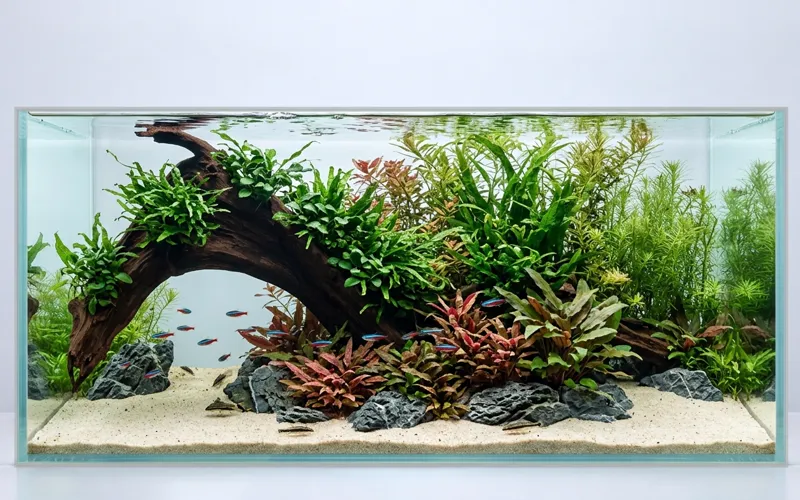
Tuskwood varies much more. There are stout roots, slender roots, highly branched roots, simpler forms, low forms, high forms, dramatic forms and roots that are more low-key. Some may be the main shape in a scape. Others should not take over at all, but just blend in with the rock, plants and fish and make the whole better.
That's why Tuskwood is sold as WYSIWYG. You get a lot more to choose from, and buy the exact root of the images, not an approximate type of root.
A root does not have to be the centre to lift the aquarium
In many aquariums, the focus is on the fish. In others, it's the plants, the rocks or the overall look. Therefore, it is wrong to say that a Tuskwood root should always be the centre of attention.
Sometimes it is. A strong, sculptural root can support the whole layout.
But just as often, Tuskwood does something more subtle. A simpler root can bring maturity to a plant aquarium. A narrower root can give direction without dominating. A darker piece of bogwood can make the colours of the fish feel stronger and the plants look more natural.
The point is not that the root should always be the most visible. The point is for it to make a real contribution.
Colour develops more quickly
Spiderwood can also darken over time. It is important to say, because it is not true that spiderwood always stays light.
The difference is that Tuskwood often develops its characteristic underwater colour more quickly. A root that looks sun-bleached or lighter in places when dry takes on a deeper, richer dark brown under water. The characteristic colour can often be seen after just two to three weeks.
That colour is a big part of the feel. The Tuskwood often takes on a dark brown tone with some hints of red, almost like mahogany. It makes the root feel warm, natural and aged, rather than like a bright decorative branch waiting to fit in.
The surface looks natural
Another difference is in the surface. Spiderwood is often sandblasted. This makes the root clean and bright, but it can also remove much of the natural surface. The result is a more industrially processed look.
Tuskwood is cleaned in a way that preserves its natural structure. Loose material is removed, while the surface retains the appearance of wood shaped by nature, rather than something smoothed and sanded to look uniform.
It's a small detail when you hold the root in your hand, but in the aquarium it makes a big difference. A natural surface captures light, shade and vegetation in a different way. It makes the root feel like part of the environment, not just something placed there.
Less slime and biofilm at the start
Many people who have used spiderwood will recognise the white or translucent film that often appears at the beginning. This is known as slime or biofilm. In many aquariums this will disappear over time, but it can be annoying and make the root feel unfinished during the break-in period.
A common cause is that the wood releases nutrients that microorganisms quickly grow on. This does not necessarily mean that everything is dangerous, but it can affect water quality and require more attention in the beginning.
Tuskwood generally behaves differently. In our experience, Tuskwood does not normally form that kind of biofilm. This makes the start calmer and makes the root feel more like a natural part of the aquarium.
Origin and history matter
Spiderwood on the market often comes from Asia and is generally made from the roots of cultivated flowering shrubs, such as azalea or rhododendron-like plants. Pesticides may be used in these growing environments, and customers often find the origin and background difficult to verify. Black Spiderwood is chemically treated to make it black; that is not the wood’s natural colour.
For us, that's part of the difference. Tuskwood is not a standardised decorative root from a uniform industrial production. Each root has grown in natural conditions and been shaped by its environment over a long time. Some have become vigorous, others twisted, others simple and calm. The differences are not a problem. They are the point.
This is also part of what gives Tuskwood its substance. When you place a Tuskwood root in your aquarium, you are adding more than something attractive: you are adding an object with a history. The root may be up to 4000 years old, or even older. It existed long before the aquarium and can make the environment feel more authentic.
It does not have to be dramatic. It can be a simple root that barely takes over at all. But knowing that it is an ancient, partially fossilised natural object changes the feeling.
Why we sell Tuskwood as WYSIWYG
If all roots looked the same, WYSIWYG would not be as important. But Tuskwood roots are not standardised clones.
One root may suit a cube aquarium perfectly. Another might be better in a long aquarium where you want an open swimming area. A third might be right for a forest feel, a fourth for a low and quiet layout.
That is why we show you the actual root. You should be able to see its shape, proportions, character and size before choosing. The aim is not for you to buy a ”type of root”. It is to help you find the root that feels right for you.
When does spiderwood still fit?
Spiderwood may still be the right choice. If you want something simple, inexpensive, branchy and familiar, it can work well, especially if you want to build quickly and are not looking for a sense of authenticity and uniqueness.
The important thing is just to know what to choose. Spiderwood often gives a recognisable look and may require more patience at the start due to slime and biofilm. Tuskwood offers more design choices, a more natural finish, faster deep colour and a look that doesn't rely on the root looking like everyone else.
In short
Choose spiderwood if you want a low price for an easy-to-grow, grassy root with a familiar look.
Choose Tuskwood if you want to create an aquarium that feels more personal and natural, and is durable and enjoyable over time.
Tuskwood is not about the root always stealing the spotlight. It can do that, if you want. But it can also be the understated detail that makes the whole aquarium feel older, neater and more considered.
That is the difference: spiderwood offers a generic, ready-made style. Tuskwood offers choice and uniqueness.
If you want to compare the branchy expression in the current range, there is a single page for branched Tuskwood roots.