Skip to content
Shipping is shown in cart

Aquarium plants: choose the right one for light, nutrition and CO2

This is a practical guide for those who want to choose aquarium plants without making the start more difficult than it needs to be. The point is not to find the “nicest” plant in the picture, but to choose plants that suit your light, your nutrition, your bottom and whether you use CO2 or not.

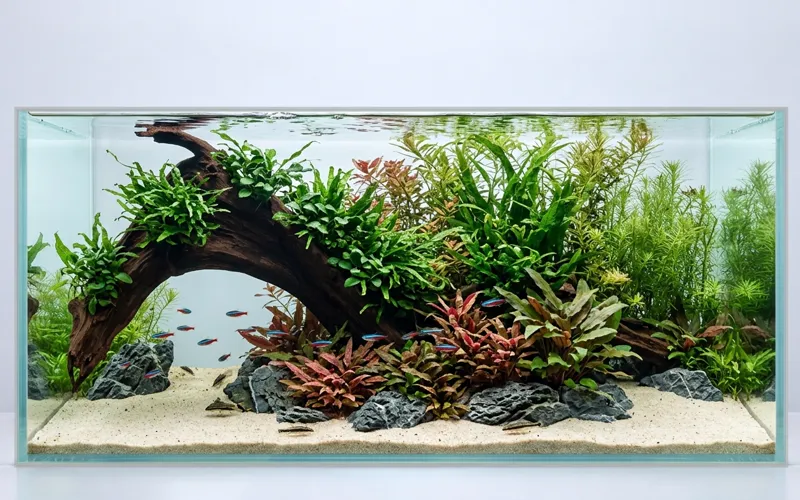
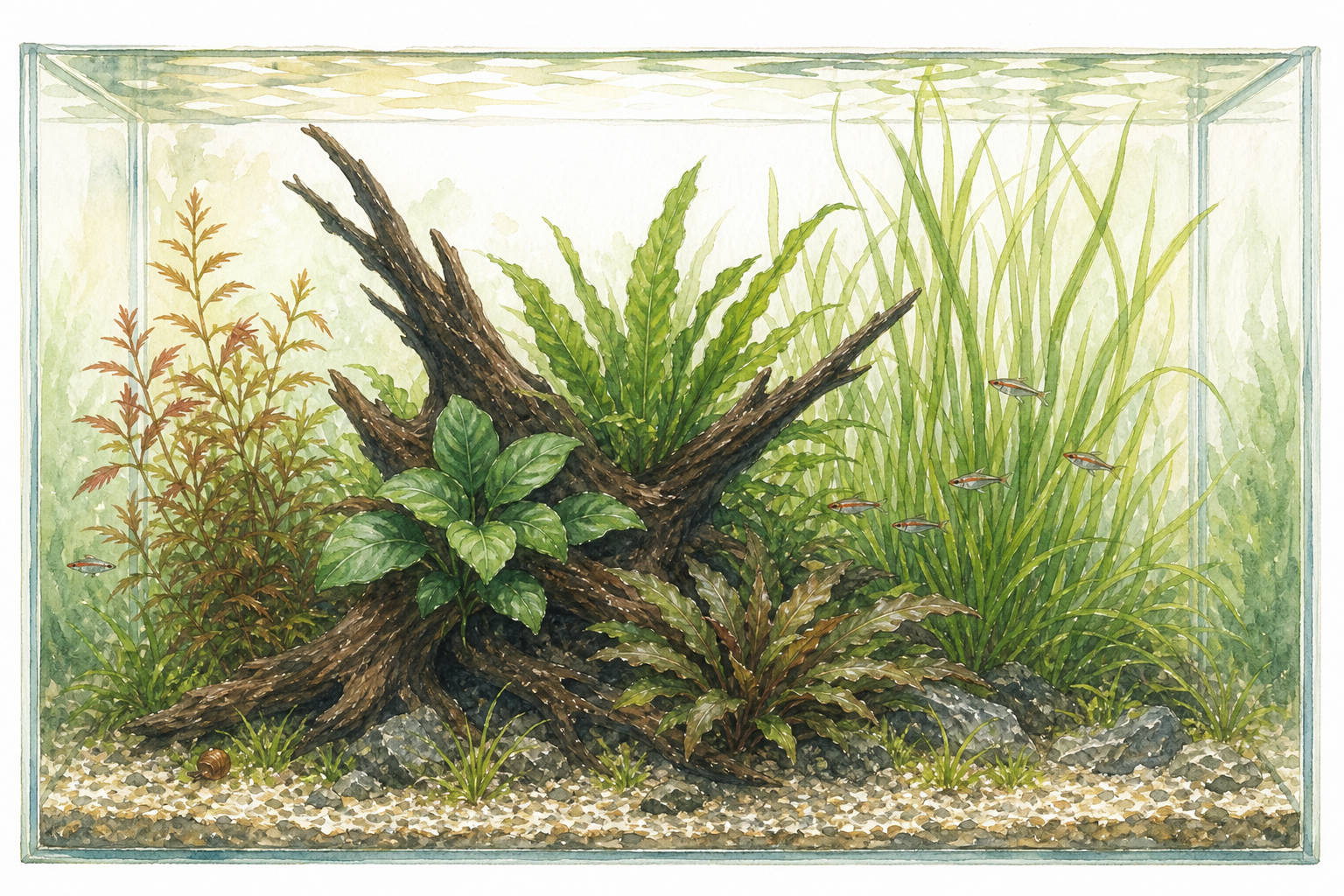
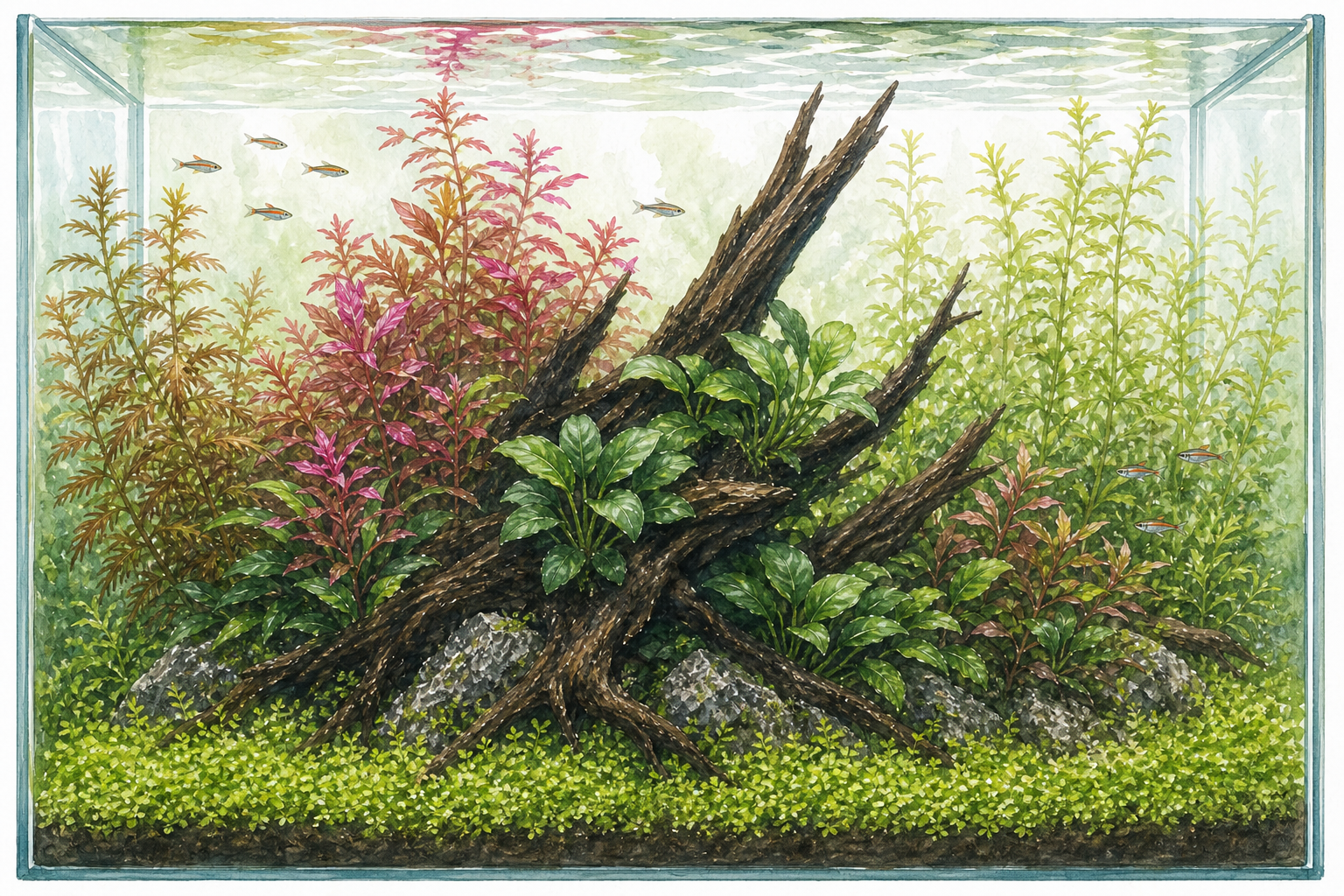
Aquascape example with a Tuskwood aquarium root and aquarium plants.

Many lush planted aquariums rely on three things at once: good lighting, consistent nutrients and added CO2. If you do not add CO2, you often need to choose a slower-growing style; otherwise, plants can easily become thin, pale or covered in algae.

It can still be very beautiful. A Tuskwood aquarium with natural root, epiphytes, moss, Cryptocoryne, Vallisneria and some hardy stem plants can feel both stable and alive without requiring high-tech equipment.
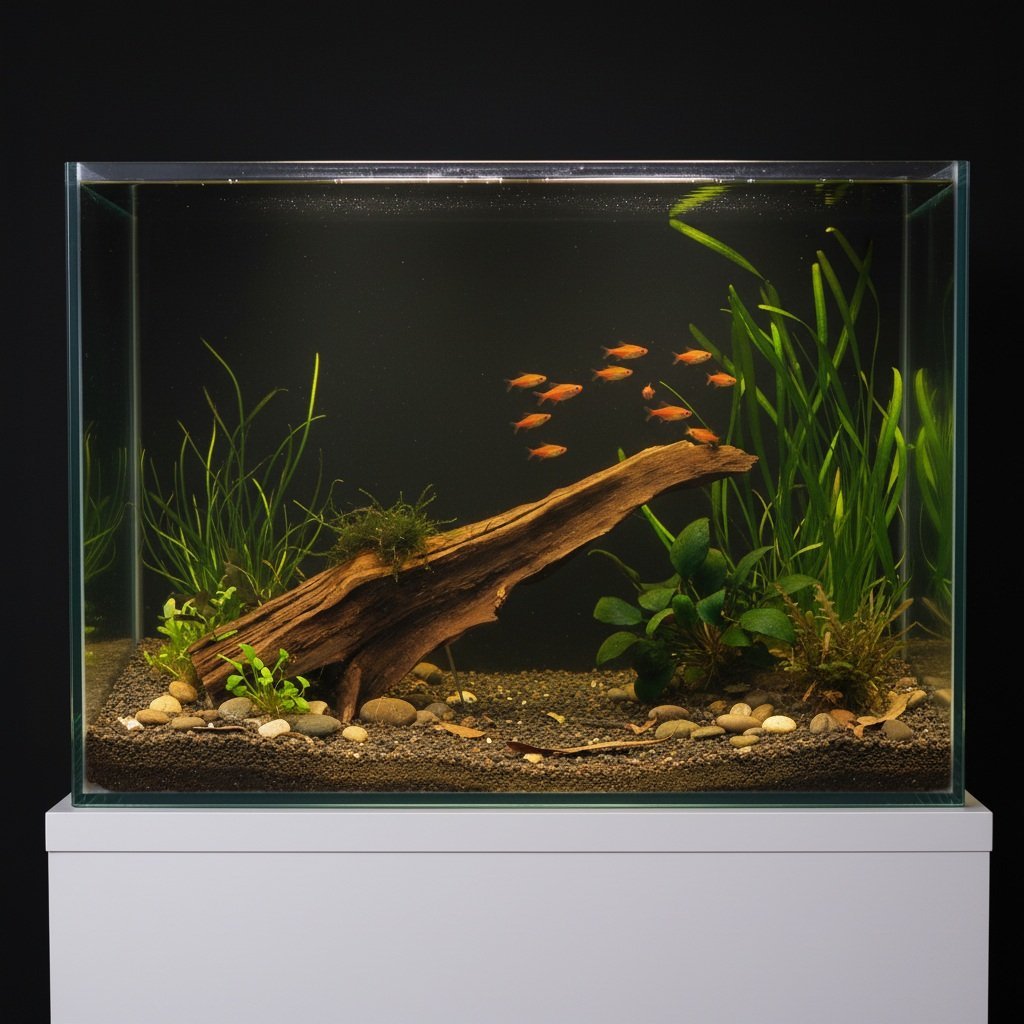
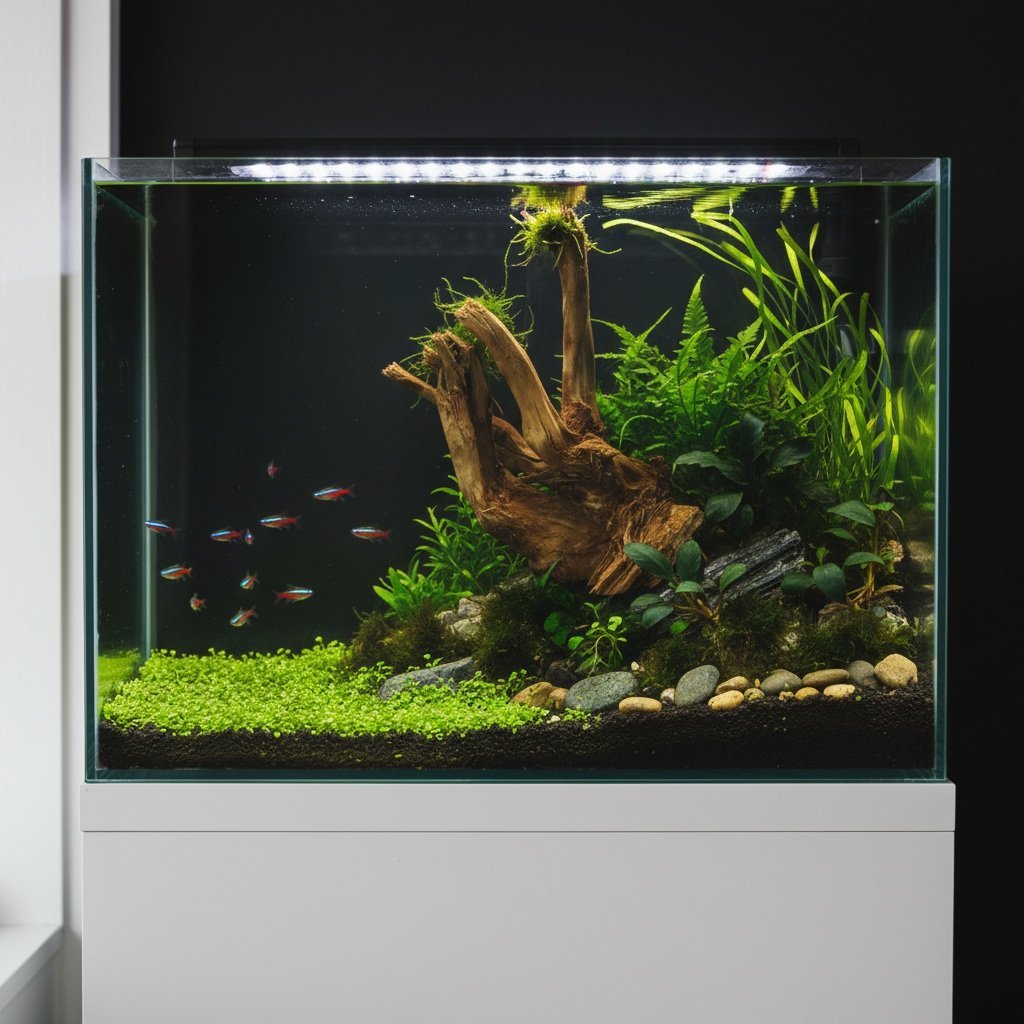
Examples of planted aquascapes with Tuskwood roots

Here are some different scape examples with Tuskwood roots. The point is that the plants don't have to do everything themselves: the root can carry structure, direction and depth, while the plants are allowed to amplify the feeling with leaf size, colour and placement.

What can you aim for?

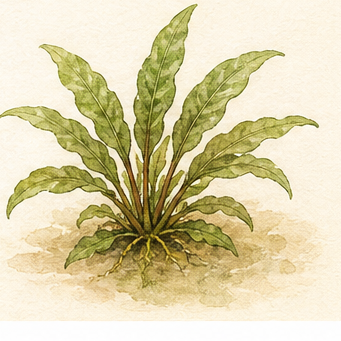
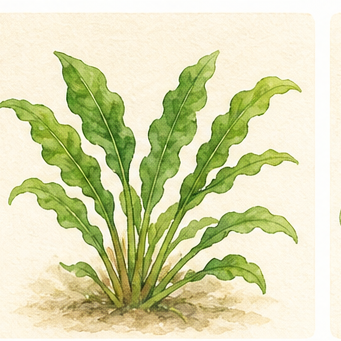
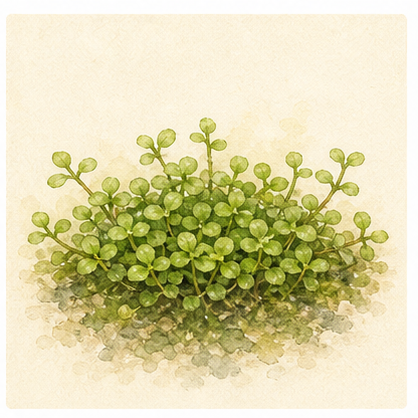
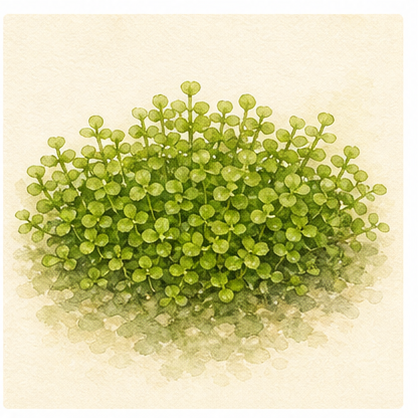
These illustrations show two approximate levels of ambition, not exact recipes. The difference is mainly about how much light, nutrients, CO2 and trimming you want to give the aquarium over time.

The illustrations are educational guides. The appearance of plants varies with light, nutrition, CO2, cultivation method and aquarium conditions.

Start with your conditions

If you don't have CO2, it's usually wise to start with simpler plants and moderate light. Bright light without enough CO2 and nutrients pushes the plants harder than the aquarium can cope with, and then the algae easily get the upper hand.

  • Without CO2: mainly choose easy-care plants, keep the lighting moderate and build much of the look with roots, stone and slower-growing epiphytes.
  • With better light but without CO2: still choose mostly easy and intermediate plants, but be cautious with dense carpets and strongly red plants.
  • With CO2: then more demanding plants, denser mats, faster trimming and stronger colours open up.

Plants on roots are often smart choices

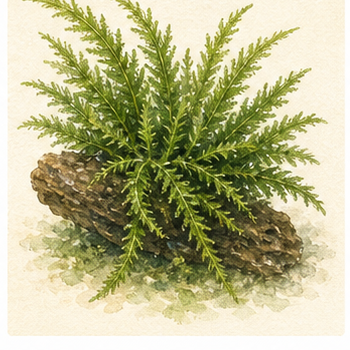
Anubias, Bucephalandra, Microsorum and many mosses are especially well suited to roots. They can be attached to Tuskwood with aquarium-safe plant glue, thin thread or fishing line until they have grown firmly in place. Plants with a rhizome should not be buried deep in the gravel, as the rhizome can start to rot.

This is also a design advantage. The root provides structure directly, while the plants are allowed to mature slowly around it. This makes the aquarium less dependent on fast-growing plant mass from the very first week.

Quick selection

  • Safe start: Anubias, Bucephalandra, Microsorum, Java moss, Cryptocoryne, Vallisneria, Sagittaria and floating plants.
  • More plant life without CO2: add hardy stem plants such as Hygrophila, Limnophila or Bacopa and keep the light even.
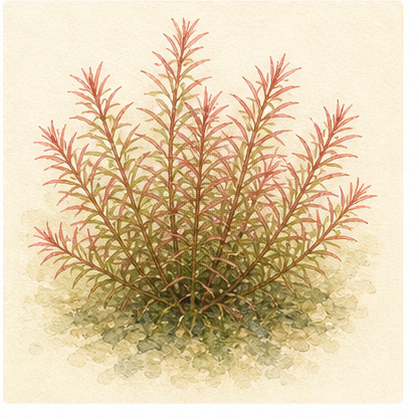
  • High-tech feel: CO2 makes a big difference for carpet plants, compact tops and red plants like Rotala, Ludwigia and Alternanthera.

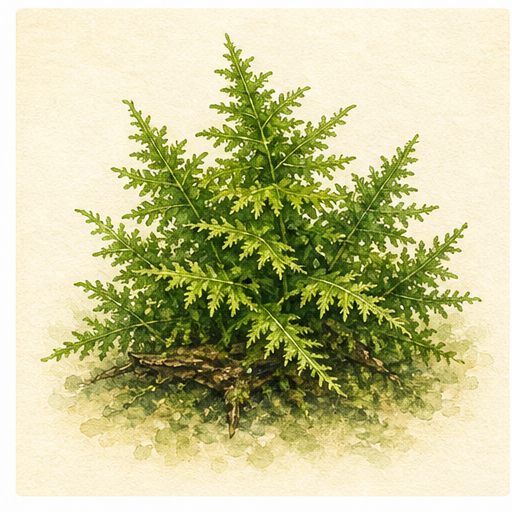
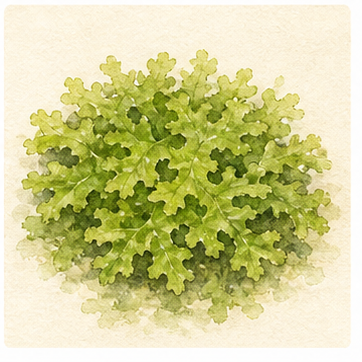
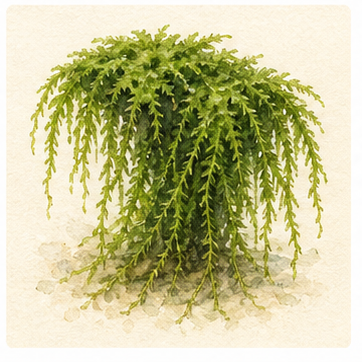
Some common plant types to recognise

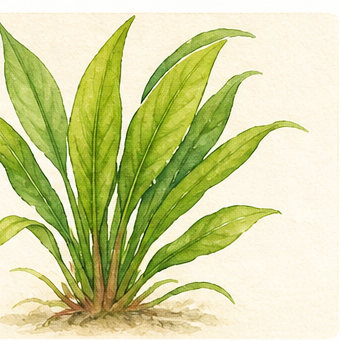
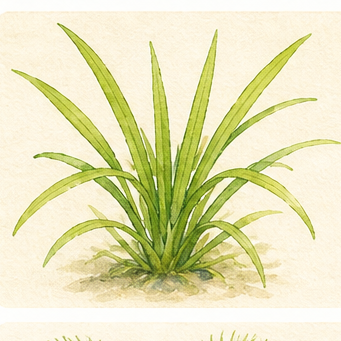
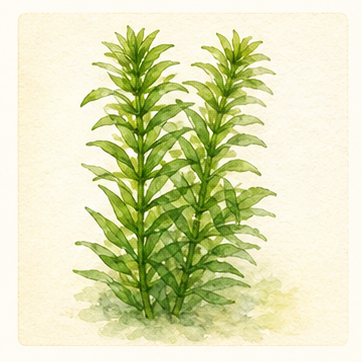
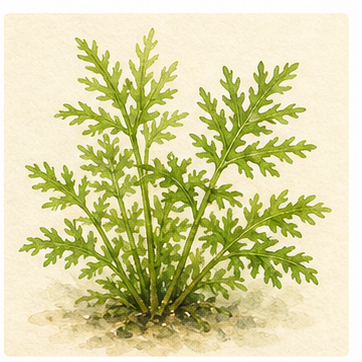
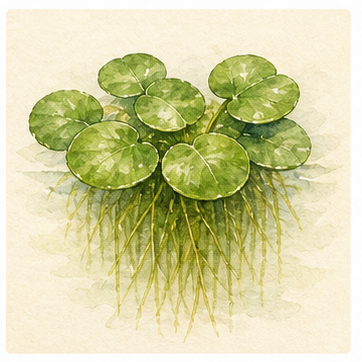
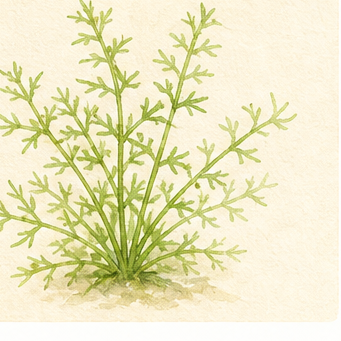
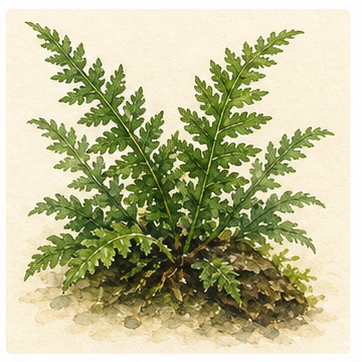
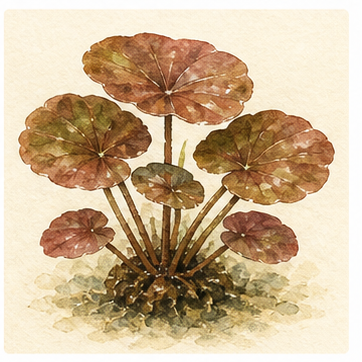
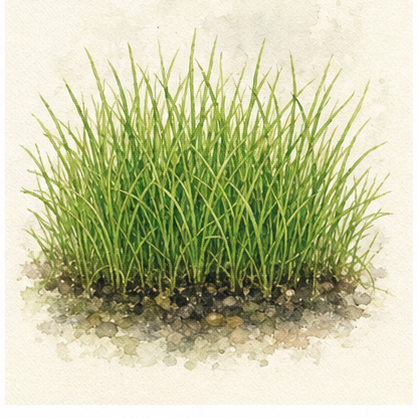
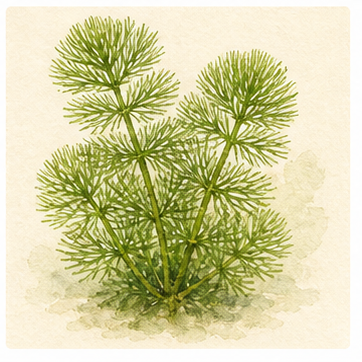
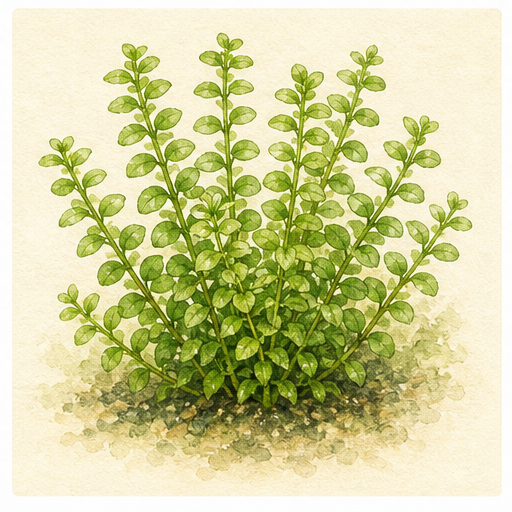
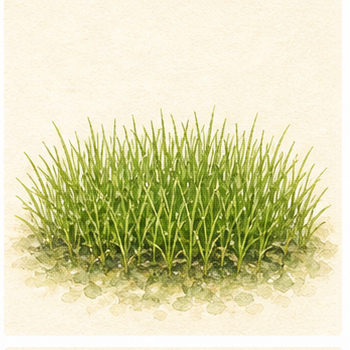
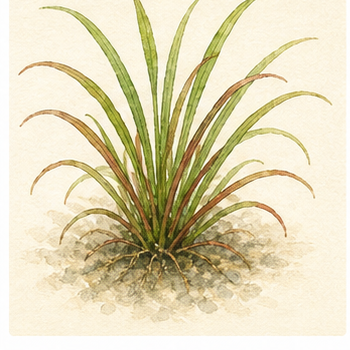
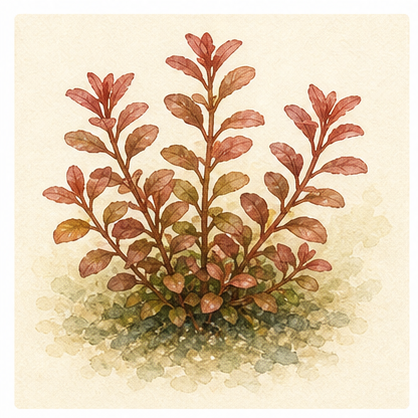
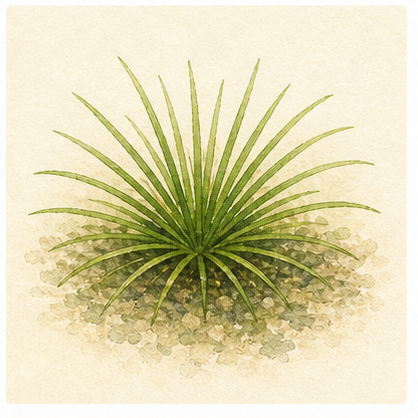
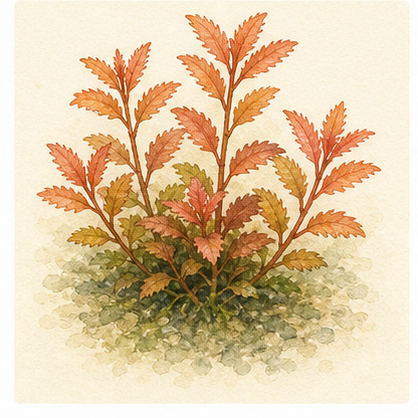
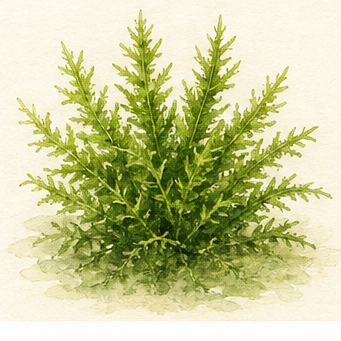
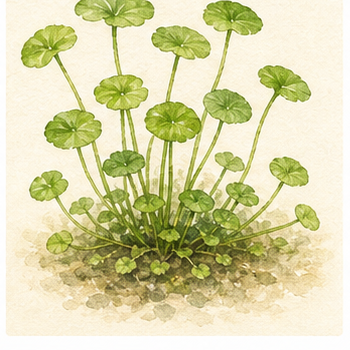
Plants become easier to choose when you consider their role in the aquarium: epiphytes on the root and rock, rosette plants in the middle section, tall background plants and stem plants that build volume and colour.

Images are simplified illustrations to show plant type and feel. Use plant names and growing advice as a guide, not as exact species identification.
Plant list sorted by Tuskwood level

The list uses Tropica as the main source of plant names and references, but the difficulty levels are sorted according to Tuskwood's practical customer perspective: what can be neat and well-developed without CO2, what will be significantly easier with CO2, and what normally requires more stable techniques and care.

Easy plants (43)

Safe low-tech start: plants that can achieve good growth, good appearance and stable development without CO2, with normal aquarium lighting, root tabs and regular liquid plant food.

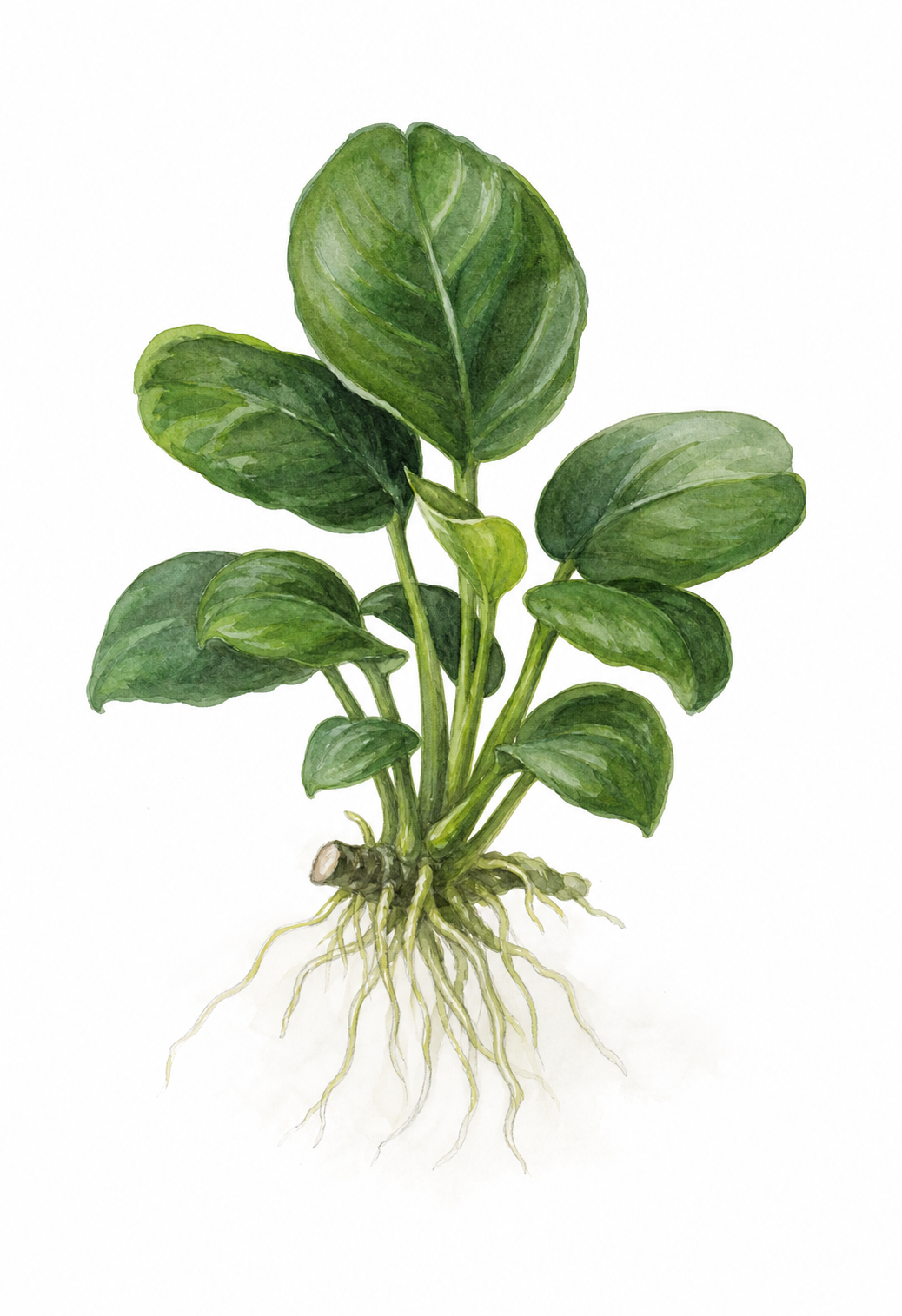
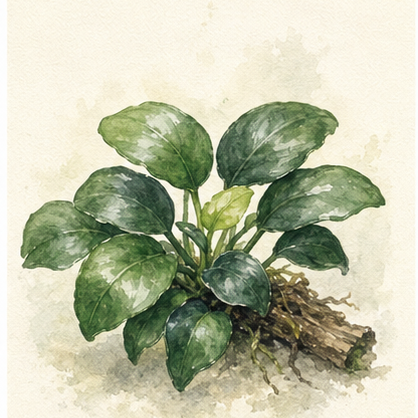
Watercolour illustration of Anubias barteri var. nana as an aquarium plant.

Anubias barteri var. nana

On root/stone Low to medium/epiphyte Green

A reliable epiphyte/rhizome plant for low-tech aquariums. Attach it to a root or stone and do not bury the rhizome.

Watercolour illustration of Bucephalandra pygmaea 'Bukit Kelam' as an aquarium plant.

Bucephalandra pygmaea ’Bukit Kelam’

On root/stone Low to medium/epiphyte Green

A reliable epiphyte/rhizome plant for low-tech aquariums. Attach it to a root or stone and do not bury the rhizome.

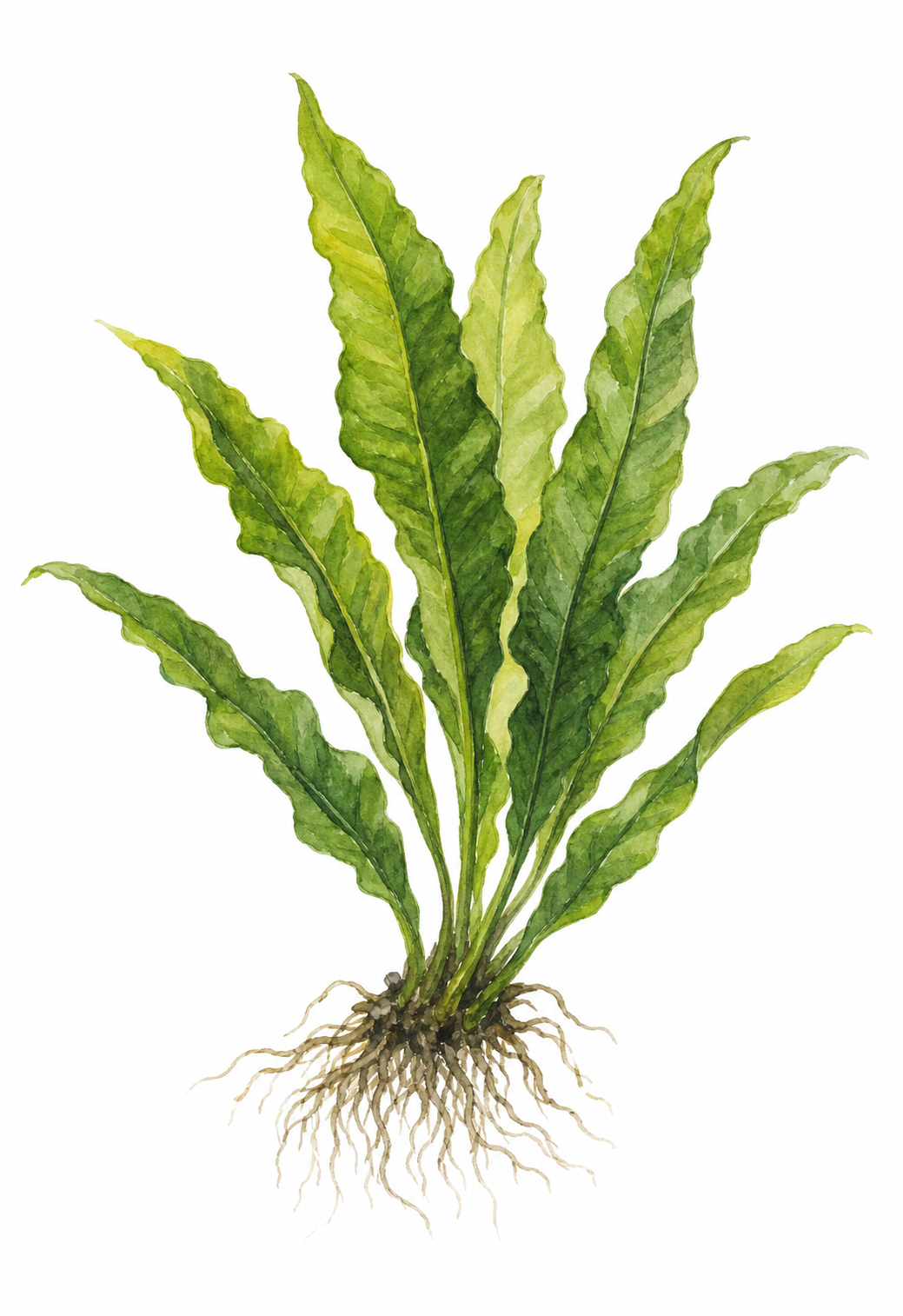
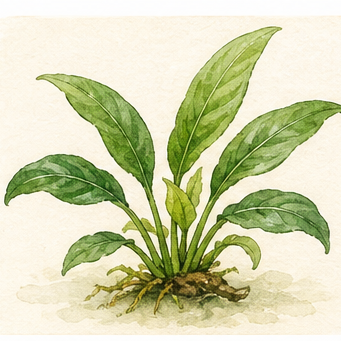
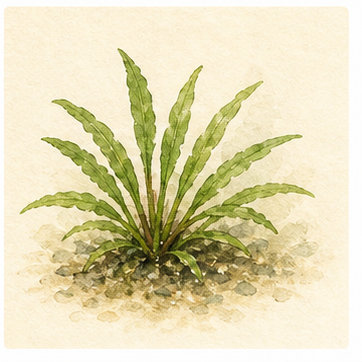
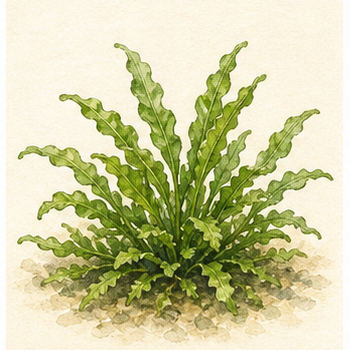
Watercolour illustration of Microsorum pteropus as an aquarium plant.

Microsorum pteropus

On root/stone Low to medium/epiphyte Green

A reliable epiphyte/rhizome plant for low-tech aquariums. Attach it to a root or stone and do not bury the rhizome.

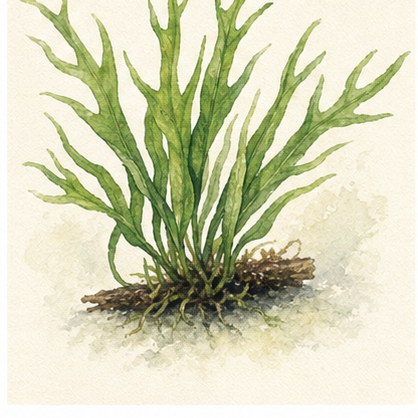
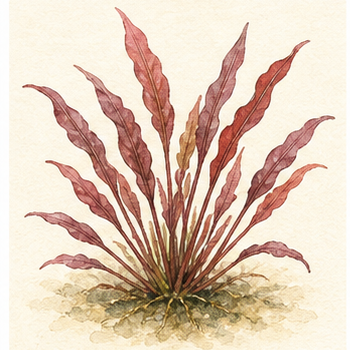
Watercolour illustration of Microsorum pteropus 'Narrow' as an aquarium plant.

Microsorum pteropus ’Narrow’

On root/stone Low to medium/epiphyte Green

A reliable epiphyte/rhizome plant for low-tech aquariums. Attach it to a root or stone and do not bury the rhizome.

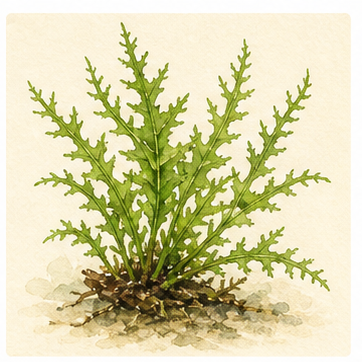
Watercolour illustration of Microsorum pteropus 'Trident' as an aquarium plant.

Microsorum pteropus ’Trident’

On root/stone Low to medium/epiphyte Green

A reliable epiphyte/rhizome plant for low-tech aquariums. Attach it to a root or stone and do not bury the rhizome.

Watercolour illustration of Microsorum pteropus 'Windeløv' as an aquarium plant.

Microsorum pteropus ’Windeløv’

On root/stone Low to medium/epiphyte Green

A reliable epiphyte/rhizome plant for low-tech aquariums. Attach it to a root or stone and do not bury the rhizome.

Watercolour illustration of Anubias gracilis as an aquarium plant.

Anubias gracilis

On root/stone Low to medium/epiphyte Light green

A reliable epiphyte/rhizome plant for low-tech aquariums. Attach it to a root or stone and do not bury the rhizome.

Watercolour illustration of Anubias barteri caladiifolia as an aquarium plant.

Anubias barteri caladiifolia

On root/stone Low to medium/epiphyte Light green

A reliable epiphyte/rhizome plant for low-tech aquariums. Attach it to a root or stone and do not bury the rhizome.

Watercolour illustration of Bucephalandra 'Kedagang' as an aquarium plant.

Bucephalandra ’Kedagang’

On root/stone Low to medium/epiphyte Dark green/blue tint

A reliable epiphyte/rhizome plant for low-tech aquariums. Attach it to a root or stone and do not bury the rhizome.

Watercolour illustration of Anubias barteri var. 'Coffeifolia' as an aquarium plant.

Anubias barteri var. ’Coffeifolia’

On root/stone Low to medium/epiphyte Red/brown

A reliable epiphyte/rhizome plant for low-tech aquariums. Attach it to a root or stone and do not bury the rhizome.

Watercolour illustration of Bucephalandra sp. 'Red' as an aquarium plant.

Bucephalandra sp. ’Red’

On root/stone Low to medium/epiphyte Red/brown

A reliable epiphyte/rhizome plant for low-tech aquariums. Attach it to a root or stone and do not bury the rhizome.

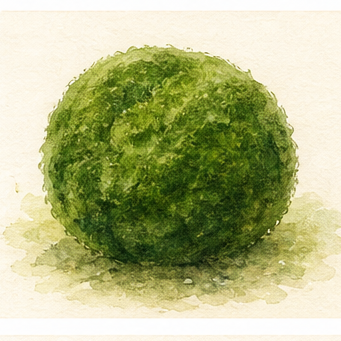
Watercolour illustration of Aegagropila linnaei as an aquarium plant.

Aegagropila linnaei

On root/stone Low-growing/epiphyte Green

Can work well in a low-tech aquarium if attached in a thin layer and trimmed so it does not shade itself.

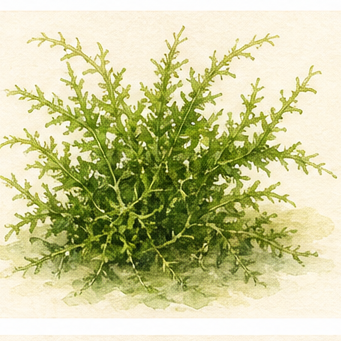
Watercolour illustration of Leptodictyum riparium as an aquarium plant.

Leptodictyum riparium

On root/stone Low-growing/epiphyte Green

Can work well in a low-tech aquarium if attached in a thin layer and trimmed so it does not shade itself.

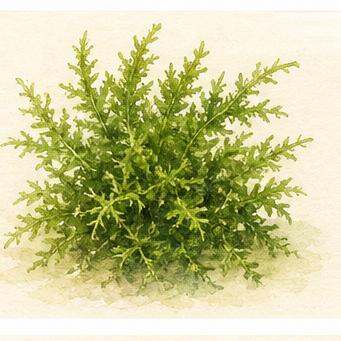
Watercolour illustration of Monosolenium tenerum as an aquarium plant.

Monosolenium tenerum

On root/stone Low-growing/epiphyte Green

Can work well in a low-tech aquarium if attached in a thin layer and trimmed so it does not shade itself.

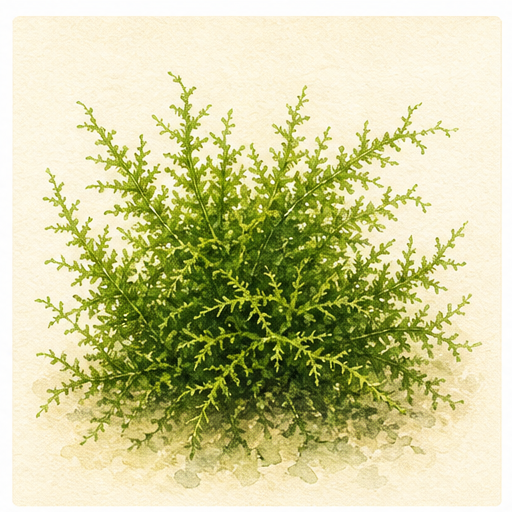
Watercolour illustration of Taxiphyllum barbieri 'Bogor Moss' as an aquarium plant.

Taxiphyllum barbieri ’Bogor Moss’

On root/stone Low-growing/epiphyte Green

Can work well in a low-tech aquarium if attached in a thin layer and trimmed so it does not shade itself.

Watercolour illustration of Taxiphyllum sp. 'Spiky Moss' as an aquarium plant.

Taxiphyllum sp. ’Spiky Moss’

On root/stone Low-growing/epiphyte Light green

Can work well in a low-tech aquarium if attached in a thin layer and trimmed so it does not shade itself.

Watercolour illustration of Sagittaria subulata as an aquarium plant.

Sagittaria subulata

Foreground/intermediate Medium Green

A hardy low-tech plant that spreads by runners when light and nutrients are consistent.

Watercolour illustration of Cryptocoryne x willisii as an aquarium plant.

Cryptocoryne x willisii

Midground Low to medium Green

A good low-tech choice with nutrients in the substrate. Add root tabs or nutrient-rich soil and let the plant establish itself gradually.

Watercolour illustration of Cryptocoryne beckettii 'Petchii' as an aquarium plant.

Cryptocoryne beckettii ’Petchii’

Midground Medium Green

A good low-tech choice with nutrients in the substrate. Add root tabs or nutrient-rich soil and let the plant establish itself gradually.

Watercolour illustration of Cryptocoryne undulata 'Broad Leaf' as an aquarium plant.

Cryptocoryne undulata ’Broad Leaf’

Midground Medium Green

A good low-tech choice with nutrients in the substrate. Add root tabs or nutrient-rich soil and let the plant establish itself gradually.

Watercolour illustration of Cryptocoryne wendtii 'Green' as an aquarium plant.

Cryptocoryne wendtii ’Green’

Midground Medium Green

A good low-tech choice with nutrients in the substrate. Add root tabs or nutrient-rich soil and let the plant establish itself gradually.

Watercolour illustration of Echinodorus cordifolius 'Fluitans' as an aquarium plant.

Echinodorus cordifolius ’Fluitans’

Midground Tall/large Light green

A good low-tech choice with nutrients in the substrate. Add root tabs or nutrient-rich soil and let the plant establish itself gradually.

Watercolour illustration of Echinodorus grisebachii 'Bleherae' as an aquarium plant.

Echinodorus grisebachii ’Bleherae’

Midground Tall/large Light green

A good low-tech choice with nutrients in the substrate. Add root tabs or nutrient-rich soil and let the plant establish itself gradually.

Watercolour illustration of Helanthium bolivianum 'Quadricostatus' as an aquarium plant.

Helanthium bolivianum ’Quadricostatus’

Midground Medium Light green

A good low-tech choice with nutrients in the substrate. Add root tabs or nutrient-rich soil and let the plant establish itself gradually.

Watercolour illustration of Cryptocoryne wendtii 'Tropica' as an aquarium plant.

Cryptocoryne wendtii ’Tropica’

Midground Medium Dark green/blue tint

A good low-tech choice with nutrients in the substrate. Add root tabs or nutrient-rich soil and let the plant establish itself gradually.

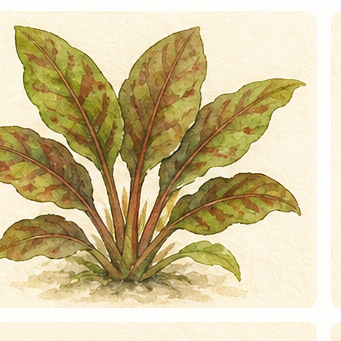
Watercolour illustration of Echinodorus 'Ozelot' as an aquarium plant.

Echinodorus ’Ozelot’

Midground Tall/large Red/brown

A good low-tech choice with nutrients in the substrate. Add root tabs or nutrient-rich soil and let the plant establish itself gradually.

Watercolour illustration of Echinodorus 'Reni' as an aquarium plant.

Echinodorus ’Reni’

Midground Tall/large Red/brown

A good low-tech choice with nutrients in the substrate. Add root tabs or nutrient-rich soil and let the plant establish itself gradually.

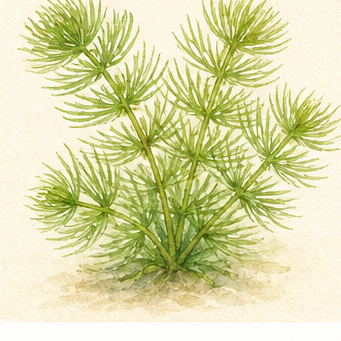
Watercolour illustration of Ceratophyllum demersum as an aquarium plant.

Ceratophyllum demersum

Background Medium Green

A hardy, fast-growing plant for ordinary lighting and standard plant fertiliser. Trim it and replant the tops for a denser shape.

Watercolour illustration of Limnophila sessiliflora as an aquarium plant.

Limnophila sessiliflora

Background Medium Green

A hardy, fast-growing plant for ordinary lighting and standard plant fertiliser. Trim it and replant the tops for a denser shape.

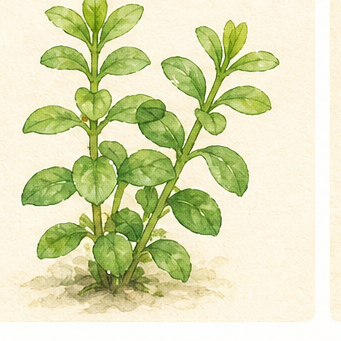
Watercolour illustration of Bacopa caroliniana as an aquarium plant.

Bacopa caroliniana

Midground/background Medium Green

A hardy, fast-growing plant for ordinary lighting and standard plant fertiliser. Trim it and replant the tops for a denser shape.

Watercolour illustration of Egeria densa as an aquarium plant.

Egeria densa

Background Medium Green

A hardy, fast-growing plant for ordinary lighting and standard plant fertiliser. Trim it and replant the tops for a denser shape.

Watercolour illustration of Hygrophila polysperma as an aquarium plant.

Hygrophila polysperma

Midground/background Medium Green

A hardy, fast-growing plant for ordinary lighting and standard plant fertiliser. Trim it and replant the tops for a denser shape.

Watercolour illustration of Bacopa monnieri 'Compact' as an aquarium plant.

Bacopa monnieri ’Compact’

Midground/background Medium Light green

A hardy, fast-growing plant for ordinary lighting and standard plant fertiliser. Trim it and replant the tops for a denser shape.

Watercolour illustration of Hygrophila difformis as an aquarium plant.

Hygrophila difformis

Background Medium Light green

A hardy, fast-growing plant for ordinary lighting and standard plant fertiliser. Trim it and replant the tops for a denser shape.

Watercolour illustration of Hygrophila corymbosa as an aquarium plant.

Hygrophila corymbosa

Background Medium Light green

A hardy, fast-growing plant for ordinary lighting and standard plant fertiliser. Trim it and replant the tops for a denser shape.

Watercolour illustration of Salvinia minima as an aquarium plant.

Salvinia minima

Floating Floating Green

Good low-tech plant for nutrient uptake and light attenuation. Keep the surface reasonably open.

Watercolour illustration of Limnobium laevigatum as an aquarium plant.

Limnobium laevigatum

Floating Low-growing Green

Practical low-tech choice with normal lighting and regular plant nutrition.

Watercolour illustration of Najas guadalupensis 'Guppy Grass' as an aquarium plant.

Najas guadalupensis ’Guppy Grass’

Midground Medium Red/brown

A hardy, fast-growing plant for ordinary lighting and standard plant fertiliser. Trim it and replant the tops for a denser shape.

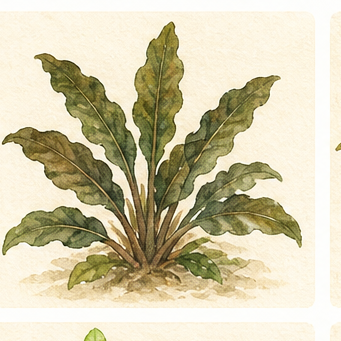
Watercolour illustration of Bolbitis heudelotii as an aquarium plant.

Bolbitis heudelotii

On root/stone Low to medium/epiphyte Dark green/blue tint

A reliable epiphyte/rhizome plant for low-tech aquariums. Attach it to a root or stone and do not bury the rhizome.

Watercolour illustration of Nymphaea lotus as an aquarium plant.

Nymphaea lotus

Midground Medium Red/brown

A good low-tech choice with nutrients in the substrate. Add root tabs or nutrient-rich soil and let the plant establish itself gradually.

Intermediate-difficulty plants (36)

Plants that will be much easier to succeed with if you run CO2, especially carpet plants, red plants and species where dense form or strong colour require more stability.

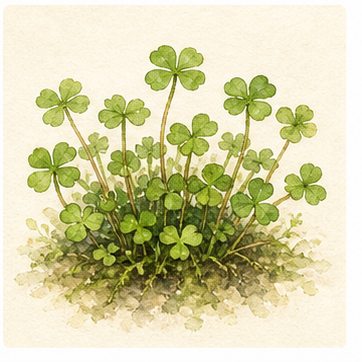
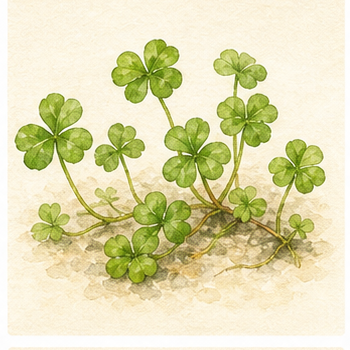
Watercolour illustration of Marsilea hirsuta as an aquarium plant.

Marsilea hirsuta

Foreground Low carpet Light green

Can be used in the foreground as a carpet, but dense, even growth is much easier with CO2, consistent nutrients and good lighting.

Watercolour illustration of Eleocharis parvula as an aquarium plant.

Eleocharis parvula

Foreground Low to medium Green

Can be used in the foreground as a carpet, but dense, even growth is much easier with CO2, consistent nutrients and good lighting.

Watercolour illustration of Lilaeopsis brasiliensis as an aquarium plant.

Lilaeopsis brasiliensis

Foreground Low-growing Light green

Can be used in the foreground as a carpet, but dense, even growth is much easier with CO2, consistent nutrients and good lighting.

Watercolour illustration of Cabomba aquatica as an aquarium plant.

Cabomba aquatica

Background Medium Green

Much easier to grow successfully when CO2, lighting and nutrients are kept consistent.

Watercolour illustration of Staurogyne repens as an aquarium plant.

Staurogyne repens

Midground Low to medium Light green

Can grow without CO2, but does better and looks better with consistent nutrients and stable conditions.

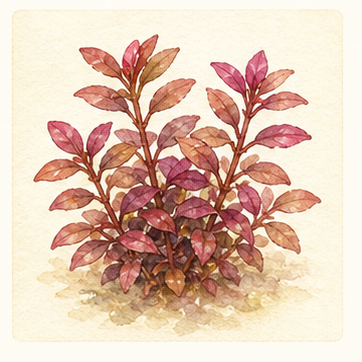
Watercolour illustration of Ludwigia repens 'Rubin' as an aquarium plant.

Ludwigia repens ’Rubin’

Midground/background Medium Red/brown

CO2 and consistent nutrients make a big difference to colour, new growth and a dense shape.

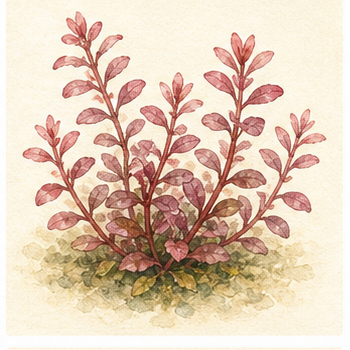
Watercolour illustration of Rotala rotundifolia as an aquarium plant.

Rotala rotundifolia

Midground/background Medium Red/brown

CO2 and consistent nutrients make a big difference to colour, new growth and a dense shape.

Watercolour illustration of Phyllanthus fluitans as an aquarium plant.

Phyllanthus fluitans

Floating Floating Red/brown

CO2 and consistent nutrients make a big difference to colour, new growth and a dense shape.

Watercolour illustration of Heteranthera zosterifolia as an aquarium plant.

Heteranthera zosterifolia

Background Medium Green

Much easier to grow successfully when CO2, lighting and nutrients are kept consistent.

Watercolour illustration of Anubias barteri 'Mini Coin' as an aquarium plant.

Anubias barteri ’Mini Coin’

On root/stone Medium Green

Can grow without CO2, but does better and looks better with consistent nutrients and stable conditions.

Watercolour illustration of Anubias barteri 'Petite' as an aquarium plant.

Anubias barteri ’Petite’

On root/stone Medium Green

Can grow without CO2, but does better and looks better with consistent nutrients and stable conditions.

Watercolour illustration of Bucephalandra sordidula 'Blue' as an aquarium plant.

Bucephalandra sordidula ’Blue’

On root/stone Medium Dark green/blue tint

Can grow without CO2, but does better and looks better with consistent nutrients and stable conditions.

Watercolour illustration of Taxiphyllum sp. 'Flame Moss' as an aquarium plant.

Taxiphyllum sp. ’Flame Moss’

On root/stone Low-growing/epiphyte Green

Looks best in a stable aquarium with clean water, consistent nutrients and regular trimming.

Watercolour illustration of Riccia fluitans as an aquarium plant.

Riccia fluitans

On root/stone Low-growing/epiphyte Light green

Looks best in a stable aquarium with clean water, consistent nutrients and regular trimming.

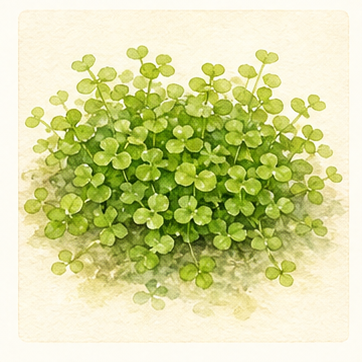
Watercolour illustration of Marsilea minuta as an aquarium plant.

Marsilea minuta

Foreground Low carpet Light green

Can be used in the foreground as a carpet, but dense, even growth is much easier with CO2, consistent nutrients and good lighting.

Watercolour illustration of Micranthemum tweediei 'Monte Carlo' as an aquarium plant.

Micranthemum tweediei ’Monte Carlo’

Foreground Low carpet Light green

Can be used in the foreground as a carpet, but dense, even growth is much easier with CO2, consistent nutrients and good lighting.

Watercolour illustration of Cryptocoryne parva as an aquarium plant.

Cryptocoryne parva

Midground Low to medium Light green

Can grow without CO2, but does better and looks better with consistent nutrients and stable conditions.

Watercolour illustration of Myriophyllum mattogrossense as an aquarium plant.

Myriophyllum mattogrossense

Background Medium Green

Much easier to grow successfully when CO2, lighting and nutrients are kept consistent.

Watercolour illustration of Pogostemon helferi as an aquarium plant.

Pogostemon helferi

Midground Low to medium Green

Much easier to grow successfully when CO2, lighting and nutrients are kept consistent.

Watercolour illustration of Hygrophila pinnatifida as an aquarium plant.

Hygrophila pinnatifida

Several zones Medium Green

Much easier to grow successfully when CO2, lighting and nutrients are kept consistent.

Watercolour illustration of Mayaca fluviatilis as an aquarium plant.

Mayaca fluviatilis

Background Medium Light green

Much easier to grow successfully when CO2, lighting and nutrients are kept consistent.

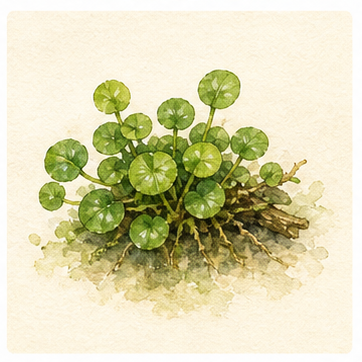
Watercolour illustration of Hydrocotyle tripartita as an aquarium plant.

Hydrocotyle tripartita

Foreground Low-growing Light green

Can be used in the foreground as a carpet, but dense, even growth is much easier with CO2, consistent nutrients and good lighting.

Watercolour illustration of Rotala indica 'Bonsai' as an aquarium plant.

Rotala indica ’Bonsai’

Midground/background Medium Red/brown

CO2 and consistent nutrients make a big difference to colour, new growth and a dense shape.

Watercolour illustration of Rotala rotundifolia 'Green' as an aquarium plant.

Rotala rotundifolia ’Green’

Midground/background Medium Red/brown

CO2 and consistent nutrients make a big difference to colour, new growth and a dense shape.

Watercolour illustration of Rotala rotundifolia 'H'ra' as an aquarium plant.

Rotala rotundifolia ’H’ra’

Midground/background Medium Red/brown

CO2 and consistent nutrients make a big difference to colour, new growth and a dense shape.

Watercolour illustration of Eleocharis pusilla 'Mini' as an aquarium plant.

Eleocharis pusilla ’Mini’

Foreground Medium Green

Can be used in the foreground as a carpet, but dense, even growth is much easier with CO2, consistent nutrients and good lighting.

Watercolour illustration of Blyxa japonica as an aquarium plant.

Blyxa japonica

Midground Low to medium Red/brown

Can be used in the foreground as a carpet, but dense, even growth is much easier with CO2, consistent nutrients and good lighting.

Watercolour illustration of Fissidens fontanus as an aquarium plant.

Fissidens fontanus

On root/stone Low-growing on root/stone Dark green

Looks best in a stable aquarium with clean water, consistent nutrients and regular trimming.

Watercolour illustration of Hydrocotyle verticillata as an aquarium plant.

Hydrocotyle verticillata

Foreground Low to medium Light green

Can be used in the foreground as a carpet, but dense, even growth is much easier with CO2, consistent nutrients and good lighting.

Watercolour illustration of Micranthemum glomeratum as an aquarium plant.

Micranthemum glomeratum

Foreground Low to medium Light green

Can be used in the foreground as a carpet, but dense, even growth is much easier with CO2, consistent nutrients and good lighting.

Demanding plants (9)

Plants for aquariums with stable CO2, stronger light, consistent nutrition and more active management.

Watercolour illustration of Ammannia crassicaulis as an aquarium plant.

Ammannia crassicaulis

Background Medium Red/brown

Needs stable CO2, stronger lighting, consistent nutrients and regular trimming for good colour and shape.

Watercolour illustration of Glossostigma elatinoides as an aquarium plant.

Glossostigma elatinoides

Foreground Low carpet Light green

Needs stable CO2, stronger lighting and consistent water conditions to form a dense, healthy carpet.

Watercolour illustration of Utricularia graminifolia as an aquarium plant.

Utricularia graminifolia

Foreground Low carpet Light green

Needs stable CO2, stronger lighting and consistent water conditions to form a dense, healthy carpet.

Watercolour illustration of Eriocaulon cinereum as an aquarium plant.

Eriocaulon cinereum

Several zones Low to medium Green

Best suited to a stable, well-maintained plant aquarium with CO2 and steady values.

Watercolour illustration of Pogostemon stellatus as an aquarium plant.

Pogostemon stellatus

Background Medium-high Green to red-green

Needs stable CO2, stronger lighting, consistent nutrients and regular trimming for good colour and shape.

Watercolour illustration of Proserpinaca palustris 'Cuba' as an aquarium plant.

Proserpinaca palustris ’Cuba’

Background Medium Orange/red

Needs stable CO2, stronger lighting, consistent nutrients and regular trimming for good colour and shape.

Watercolour illustration of Rotala macrandra as an aquarium plant.

Rotala macrandra

Background Medium-high Red

Needs stable CO2, stronger lighting, consistent nutrients and regular trimming for good colour and shape.

Watercolour illustration of Rotala wallichii as an aquarium plant.

Rotala wallichii

Background Medium Red-green

Needs stable CO2, stronger lighting, consistent nutrients and regular trimming for good colour and shape.

The illustrations are educational guide images. The appearance of plants can vary depending on light, nutrition, CO2, cultivation method and aquarium conditions.

Next steps

If in doubt: choose the root first, especially if it is to carry much of the scape. Then choose plants that enhance the shape. Larger leaves and sturdier plants often fit closer to the foreground, while smaller leaves and finer texture can give more depth further back.

Sources and delimitation

The plant list uses Tropica's public plant database as the main source for names and difficulty levels. The advice on the page is written for common home aquarium and Tuskwood layouts, not as an exact growing manual for each species.

Select your currency
Scroll to Top